Vicat a défini une trajectoire claire de décarbonation de son activité cimentière pour atteindre son ambition de neutralité carbone sur l’ensemble de la chaîne de valeur d’ici 2050 autour de quatre leviers d’actions, le dernier levier étant d'initier 2 projets de CCU/CCS (Carbon Capture Usage/Storage).
Le captage du CO2 c’est quoi ?
Le captage et stockage du CO2 représentent une rupture technologique essentielle et indispensable pour traiter les émissions inévitables de CO2 issues du procédé lié à la décarbonatation du calcaire. C'est un levier essentiel pour atteindre l'ambition de décarbonation du groupe Vicat à horizon 2050 : contribuer à la neutralité carbone sur toute notre chaîne de valeur, en déployant une stratégie de décarbonation de nos produits, services et de nos processus industriels.
La technologie de Captage, d’Utilisation et de Séquestration du Carbone (CCUS) peut permettre de séquestrer jusqu'à près de 100% des émissions résiduelles de nos cimenteries, qui ne sont pas abattables par d’autres mesures. Dans ce cadre, nous déployons un projet majeur, le projet VAIA (Vicat Advanced Industrial Alliance).
Le projet VAIA, projet CCS majeur du groupe Vicat
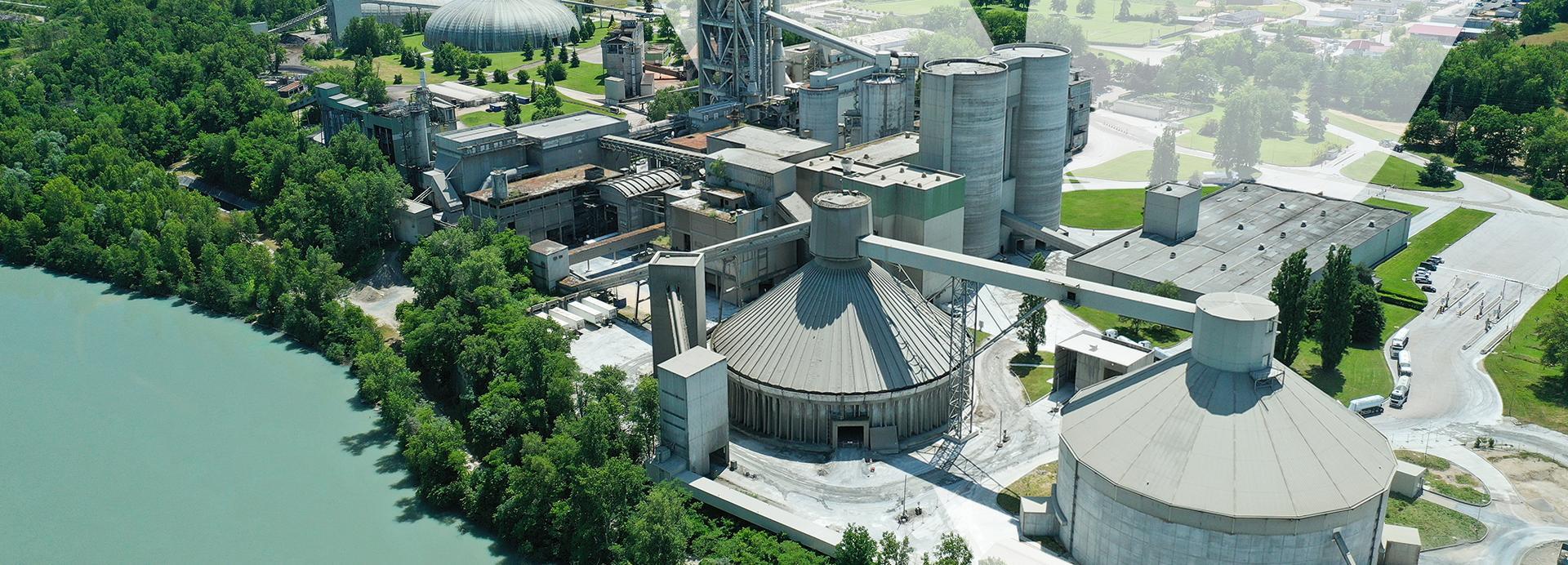
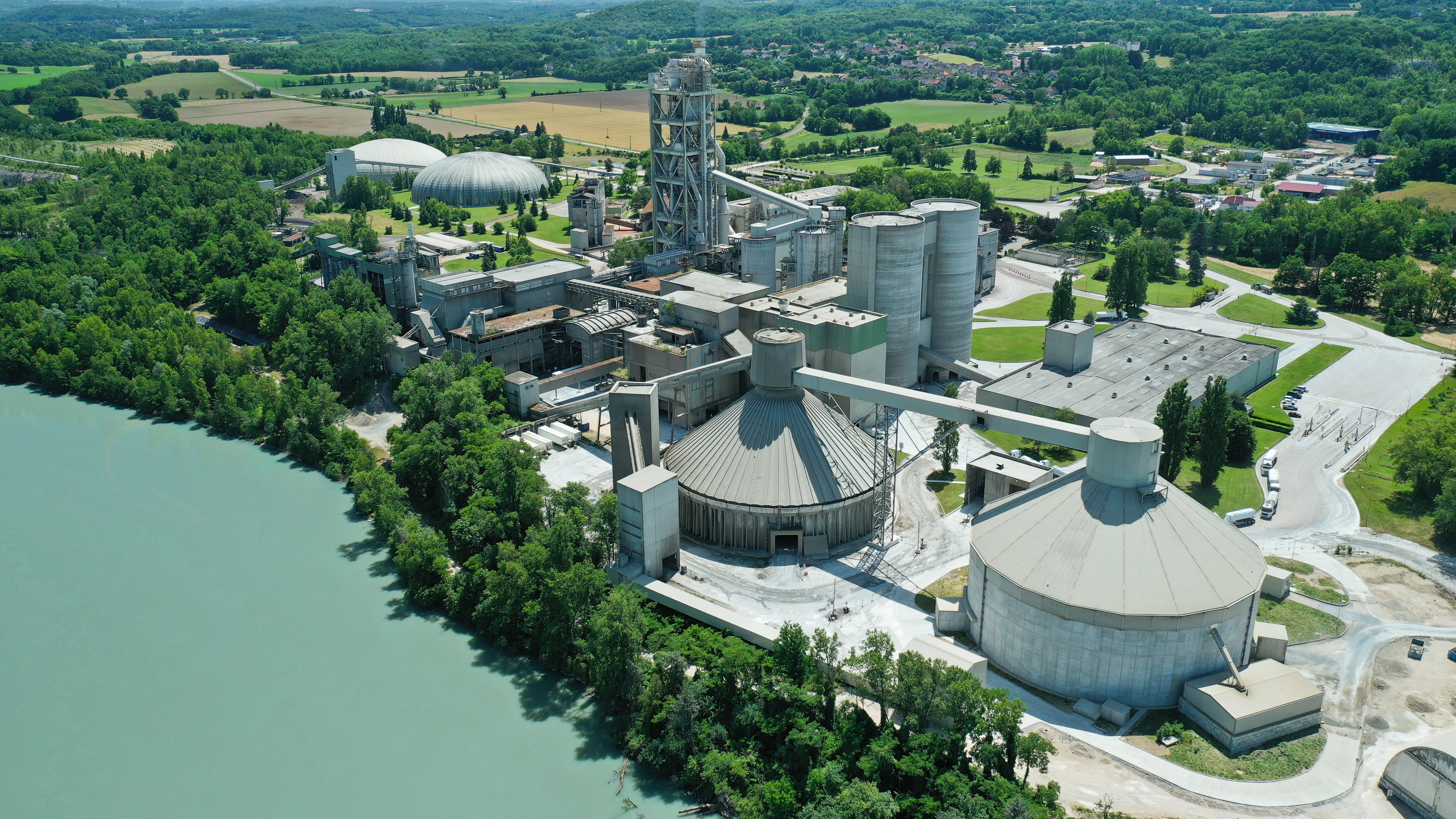
La cimenterie de Montalieu, la plus grande cimenterie de France au cœur du projet
Le site de Montalieu en Isère est le plus important de France en termes de capacité de production, avec une production annuelle de plus de 2 millions de tonnes de ciment.
Implantée au cœur du département sur les communes de Montalieu-Vercieu et Bouvesse-Quirieu, la cimenterie de Montalieu constitue l’un des sites industriels historiques et stratégiques du groupe Vicat. Mise en service au début du XXᵉ siècle, elle s’est continuellement modernisée pour devenir aujourd’hui l’une des plateformes cimentières les plus performantes et innovantes du Groupe.
Située à proximité immédiate des carrières de matières premières de Enieu et Mépieu, la cimenterie bénéficie d’un approvisionnement de proximité et sécurisé en calcaire et en argile, garantissant régularité et qualité pour servir nos clients sur le marché local. Dotée d’un four de grande capacité et d’une capacité de broyage ciment adaptée, elle produit plusieurs types de ciments dont du ciment bas carbone destinés aux marchés du bâtiment, du génie civil et des infrastructures situés dans un rayon d’action de 200 km.
Avec une centaine de collaboratrices et collaborateurs et un savoir‑faire reconnu, la cimenterie de Montalieu s’inscrit pleinement dans la trajectoire bas carbone du groupe Vicat et joue un rôle clé dans l’approvisionnement en ciment de la région Auvergne‑Rhône‑Alpes.
Engagée dans une démarche industrielle durable, la cimenterie de Montalieu est un site de référence pour :
- la réduction de l’empreinte carbone, avec un recours croissant aux combustibles alternatifs. L’usine est proche des 80% de substitution aujourd’hui ;
- l’innovation matériaux, notamment via des formulations « bas carbone » avec le liant CARAT intégrant du biochar ;
- l’économie circulaire, par la valorisation de terres excavées issues de friches industrielles locales ;
- l’ancrage local, grâce à un partenariat fort avec les collectivités, les riverains, les écoles et les acteurs économiques du territoire.
Projet VAIA, fer de lance de la décarbonation de la vallée du Rhône
“Vicat avec son projet VAIA est le catalyseur de la décarbonation de l’industrie sur tout l’axe rhodanien.”
Eric Bourdon, DGA, Directeur industriel et innovations du groupe Vicat
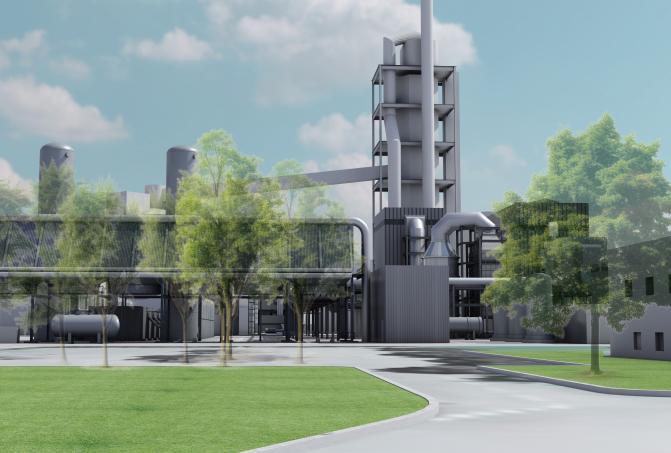
Le projet de décarbonation VAIA vise à éradiquer toutes les émissions de CO2 émises sur le site et faire de Montalieu la première cimenterie à empreinte carbone neutre d’ici 2050. Cela correspond à pouvoir capter un total de 1,2 million de tonnes de CO2 inévitables par an sur ce site, soit la totalité des émissions de CO2 fatales et non abattables par d’autres mesures du site.
En complément, le projet Activat permettra d’éviter l’émission de 200 000 tonnes de CO2 supplémentaires grâce à l’électrification d’un procédé d’activation de matières locales. Le procédé d’activation de matières désigne l’ensemble des techniques utilisées pour rendre la matière plus réactive, plus fonctionnelle ou plus performante.
VAIA permet également la création d’une chaîne de valeur carbone et constitue le point d’ancrage d’une filière complète de capture, de transport et de séquestration de CO2 dans toute la vallée du Rhône jusqu’à Fos-sur-Mer.
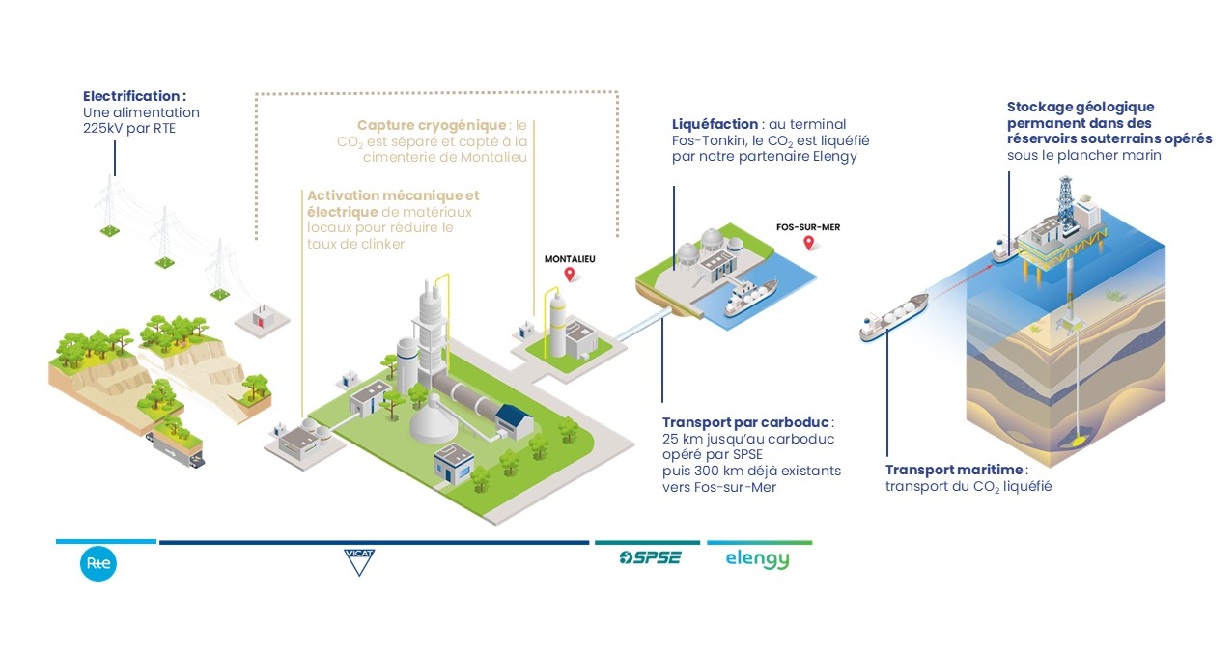
Le CO2 capté sera transporté via un pipeline existant, converti en «carboduc» jusqu’à Fos-sur-Mer où il sera liquéfié puis transporté par voie maritime jusqu’au site de stockage géologique pour une séquestration permanente. Une partie de ce CO2 pourra être prélevée sur le carboduc pour être valorisée par exemple en e-SAF (Sustainable Aviation Fuel ou kérozène de synthèse) entrant dans la composition du kérosène bas carbone de demain. Le projet VAIA initie le désenclavement carbone d’une région industrielle majeure de la France.
VAIA s’inscrit dans le projet global Rhône Décarbonation, qui a reçu un bilan positif lors de la concertation préalable et est soumis à une concertation continue depuis fin 2025.
Les 6 attendus du projet VAIA
1 - Réduction massive des émissions de CO₂ : plus de 20 millions de tonnes de CO₂ évitées les quinze premières années,
2 - Industrialisation des technologies de captage pour aller vers une massification à l’échelle de toute l’industrie lourde,
3 - Création d’une chaîne de valeur économique et d’emplois,
4 - Soutien à la souveraineté énergétique et industrielle européenne,
5 - Optimisation des coûts et de l’efficacité en connectant les infrastructures de captage du CO₂ dans toute la vallée du Rhône,
6 - Réduction des impacts environnementaux grâce à une approche circulaire de l’eau et des ressources, et via le réemploi d’infrastructures existantes.
Comment le CO2 est-il capté ?
Le projet doit permettre de capter la totalité des émissions de CO2 de la cimenterie de Montalieu, soit 1,2 million de tonnes d’émissions de CO2 par an. Le procédé de captage du CO2, sélectionné dans le cadre du projet VAIA, est un procédé cryogénique.
Les gaz émis dans le cadre de la fabrication du clinker, constituant principal et indispensable du ciment, sont traités pour réduire les teneurs en particules solides, oxydes de soufre (SOx) et oxydes d’azote (NOx) nocifs pour l’installation de captage en aval. Les gaz sont ensuite préconcentrés en CO2et comprimés avant d’entrer dans une unité cryogénique (refroidissement intense). Les gaz comprimés sont ainsi refroidis à des températures proches de -55 °C. Le CO2 s’approchant de son point de condensation est alors collecté puis purifié pour être adapté aux conditions propres à son transport terrestre par carboduc et à son utilisation ou à sa séquestration géologique permanente.
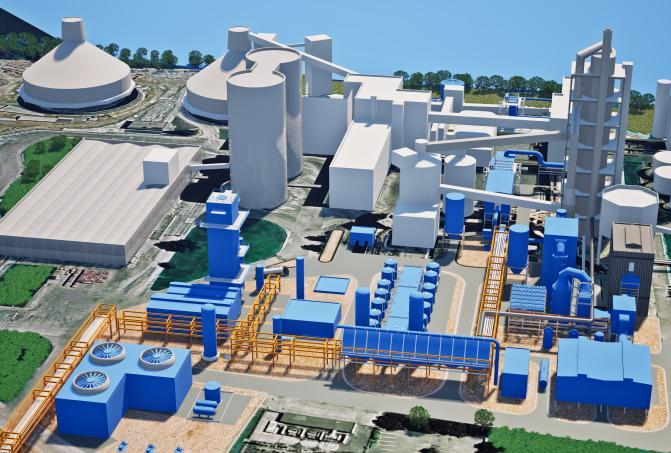
Deux technologies principales pour atteindre nos objectifs de décarbonation :
1/ ELECTRIFICATION DES PROCEDES D’ACTIVATION DES MATERIAUX LOCAUX
- Permet la réduction du taux de clinker grâce à l'utilisation de matériaux locaux
- Procédé électrifié sans chaleur et utilisant des matériaux du territoire
2/ CAPTURE CRYOGÉNIQUE DU CO2
- Procédé de distillation par le froid 100% électrifié pour isoler et capter le CO2
- Procédé propre : sans émissions polluantes et sans consommation d'eau supplémentaire
Du captage au stockage : une chaîne de décarbonation complète
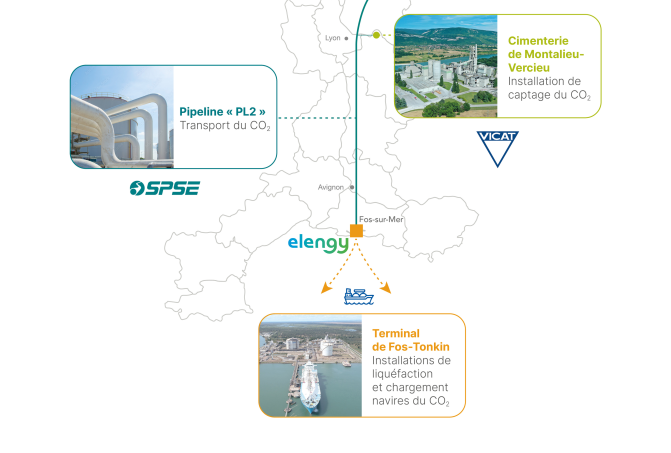
Une fois capté sur le site de Montalieu, le CO2 est acheminé sous forme gazeuse jusqu’au terminal reconverti d’Elengy à Fos-Tonkin via le carboduc de transport exploité par la Société SPSE.
Le CO2 est ensuite traité grâce à des unités de pré-traitement pour éliminer les traces d’eau et certaines impuretés pour atteindre les spécifications requises pour son transport puis séquestration. Le CO2 liquéfié est stocké temporairement sur le site de Fos-sur-Mer avant d’être chargé sur des navires spécialisés dans le transport de CO2 liquéfié (LCO2). Ce sont ces navires adaptés aux chaînes CCS qui achemineront le CO2 jusqu’au site de séquestration géologique, consistant à piéger le CO2 dans des roches réservoirs sous la surface de la Terre. Les zones de stockage peuvent être de plusieurs natures soit dans des aquifères salins profonds, soit dans des anciens gisements pétroliers et gaziers déplétés (en fin de vie).
Dans le cadre du projet VAIA, les opérateurs de la chaine de valeur du CCS en aval du terminal de liquéfaction de Fos-sur-Mer, c’est-à-dire les opérateurs des navires pour le transport maritime et l’opérateur pour la séquestration définitive du CO2 n’ont pas été choisis à ce stade du projet.
Chaîne complète du captage au stockage
titre
Nos partenaires
VAIA unit le savoir-faire et les expertises d’acteurs français (Vicat, SPSE, Elengy, RTE) sur un axe stratégique de la vallée du Rhône.
Le projet repose sur une collaboration industrielle d’excellence :
- Vicat, pour le captage du CO2 sur la cimenterie de Montalieu
- SPSE, pour le transport terrestre du CO₂ et la reconversion d’un pipeline existant en carboduc,
- Elengy, pour la liquéfaction du CO₂ et le chargement des navires,
- RTE, pour la fourniture d’énergie sur les sites de captage et de liquéfaction.
VAIA va contribuer au maintien, au savoir-faire et à la dynamique de l’industrie sur les territoires concernés tout en réutilisant des infrastructures déjà existantes.
Mise en service à horizon 2030
2023 :
Etudes techniques préliminaires
2024 :
AMI Rhône CO2
2024 :
Candidature IF et GPID
2025 - 2027 :
Etudes d’ingénierie de base
2027 :
Décision d’investissement
2028 - 2030 :
Réalisation
2030 :
Mise en service (Objectif : 1,2 Mt captées / stockées) avec une montée en régime en synergie avec d'autres acteurs industriels
2035 - 2040 :
Massification du CCUS et de l’usage des infrastructures le long de la vallée du Rhône (capacité supérieure à 4Mt/an)
VAIA permet de lancer la décarbonation de l'ensemble de la vallée du Rhône et au-delà : en effet, cette chaine CCUS, une fois lancée par VICAT (horizon 2030), pourra s’étendre jusqu'en Europe grâce au même carboduc existant de SPSE mais remontant vers le Nord, avec le raccordement de nouveaux émetteurs et de nouveaux utilisateurs ouvrant la voie au maintien et à la création de nouvelles industries sur une large géographie de l’Hexagone.
En savoir plus sur la séquestration du CO2
titre
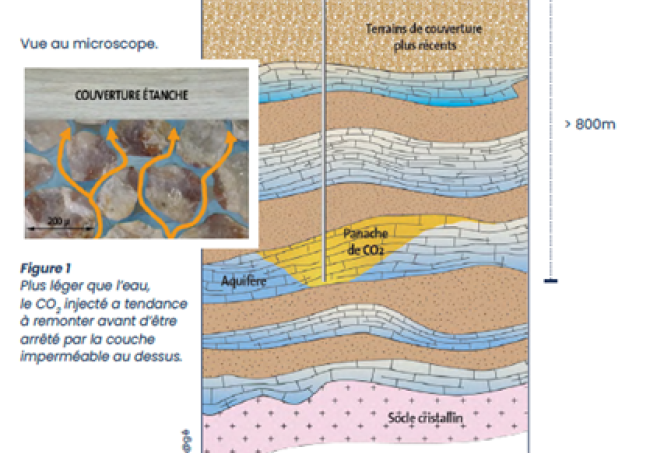
Stocker de manière sûre et permanente le CO2
Des réservoirs géologiques offshore existent déjà :
Profondeur supérieure à 800m sous la mer
Formation géologique composée de roche poreuse et perméable (grès, calcaire)
Cadre règlementaire sur la sécurité du stockage
Réglementation européenne (Directive Européenne 2009/31/EC)
En France, lignes de conduite sur la sécurité des sites de stockage (Code de l’environnement)
Normes ISO 27914/2017 portant sur la Capture, Transport et Stockage du CO₂
Les sites de stockage sont tenus à une surveillance stricte de l’extension du panache de CO2 dans le réservoir et à l’absence de fuite
Premiers financements obtenus
Le projet VAIA est cofinancé par l’Union Européenne et soutenu également par le gouvernement français via le GPID (Grands Projets Industriels de Décarbonation) attribué le 12 février 2026.
Vicat a obtenu une subvention de 149 998 000 euros suite à sa candidature au programme européen Innovation Fund 2024, ainsi qu’au dispositif français GPID donnant accès sous conditions à un montant total cumulé de 340M€ d’aides publiques pour un investissement total estimé entre 700 et 900 millions d'euros et des coûts opérationnels significativement élevés.
La subvention GPID s’inscrit dans le cadre des Grands Plans d’Investissement portés par le gouvernement français pour accélérer la transition écologique et industrielle du pays. Ce dispositif vise à soutenir des projets innovants et structurants, en particulier ceux qui contribuent à la décarbonation de l’industrie, à la modernisation des infrastructures et à la compétitivité des filières stratégiques.

« Financé par l’Union européenne. Les points de vue et opinions exprimés n’engagent toutefois que leur(s) auteur(s) et ne reflètent pas nécessairement ceux de l’Union européenne ou de l’Agence exécutive européenne pour le climat, les infrastructures et l’environnement (CINEA). Ni l’Union européenne ni l’autorité de subvention ne peuvent en être tenues responsables. » (Art. 17.3)
Questions fréquentes
Oui. Le GIEC (Groupe d'experts intergouvernemental sur l'évolution du climat) identifie le CCUS comme une technologie essentielle pour atteindre la neutralité carbone dans l'industrie lourde. Le CO₂ capté est séquestré de manière permanente dans des réservoirs géologiques stables, avec un stockage sécurisé sur des millénaires.
VAIA est un projet industriel d'envergure inédite : capter 1,2 million de tonnes de CO₂ par an (quasi 100% des émissions) nécessite une unité de captage cryogénique, 20 km de pipeline, une infrastructure de liquéfaction et un réseau de transport maritime. Les 700-900 millions d'euros investis créeront 1 000 emplois durant les travaux et 30 postes pérennes, tout en positionnant Montalieu comme la première cimenterie française zéro émission. Sans cet investissement, impossible d'atteindre nos objectifs 2050.
Argilor (opérationnel depuis 2024) combine substitution du clinker par de l'argile activée ET réduction des émissions (-20% sur le site de Xeuilley). VAIA va plus loin : il capte les émissions résiduelles après tous les autres leviers de décarbonation, visant quasi 100% de capture sur Montalieu. Argilor optimise le procédé, VAIA également, mais traite aussi les émissions inévitables. Les deux approches sont complémentaires.
Le projet est conditionné à l'obtention d'aides publiques significatives (Innovation Fund européen, GPID français), à un contexte favorable à la décarbonation d'une industrie souveraine et à l'acceptation territoriale via la concertation publique CNDP (www.rhône-décarbonation.fr). La décision finale d'investissement sera prise en 2027 après validation de tous ces critères. Nous avançons avec prudence et transparence, fidèles à notre engagement "dire ce qu'on fait, puis faire ce qu'on dit".
Notre ambition est d'initier deux projets majeurs de CCU/CCS d'ici 2030 dont le projet VAIA qui permet la création d'une chaîne de valeur carbone. Parallèlement à VAIA, Vicat est partie prenante du projet partenarial Catch4Climate regroupant Schwenk, Heidelberg Materials et Dyckerhoff à Mergelstetten en Allemagne, avec Ci4C (Cement Innovation for Climate). Il s'agit de la construction d'une installation pilote « semi-industrielle » qui permet d'obtenir des gaz à la sortie de l'installation en moindre quantité et fortement concentrés en CO₂, rendant son captage quasi intégral à la fois plus simple et plus performant grâce à une technologie de rupture « le procédé Pure Oxyfuel ». Le déploiement sur d'autres sites du Groupe dépendra du succès de ces initiatives, de la disponibilité des infrastructures de stockage et des soutiens financiers publics. Notre approche est progressive mais déterminée.
Télécharger les documents relatifs au projet