


3D concrete printing
Innovation in the blood
The construction material expert Vicat delivers innovative solutions to various sectors including complex structure manufacturing (building, public works, architecture, civil engineering), bespoke design (furniture, urban planning) and biodiversity.
Its Lithosys brand can push the boundaries of concrete material and its performance thanks to its 3D printing technology. It offers the perfect combination of construction and digital innovation and our cement production expertise, for attractive, efficient and sustainable creations.
Vicat’s expertise in concrete 3D printing
What is 3D concrete printing ?
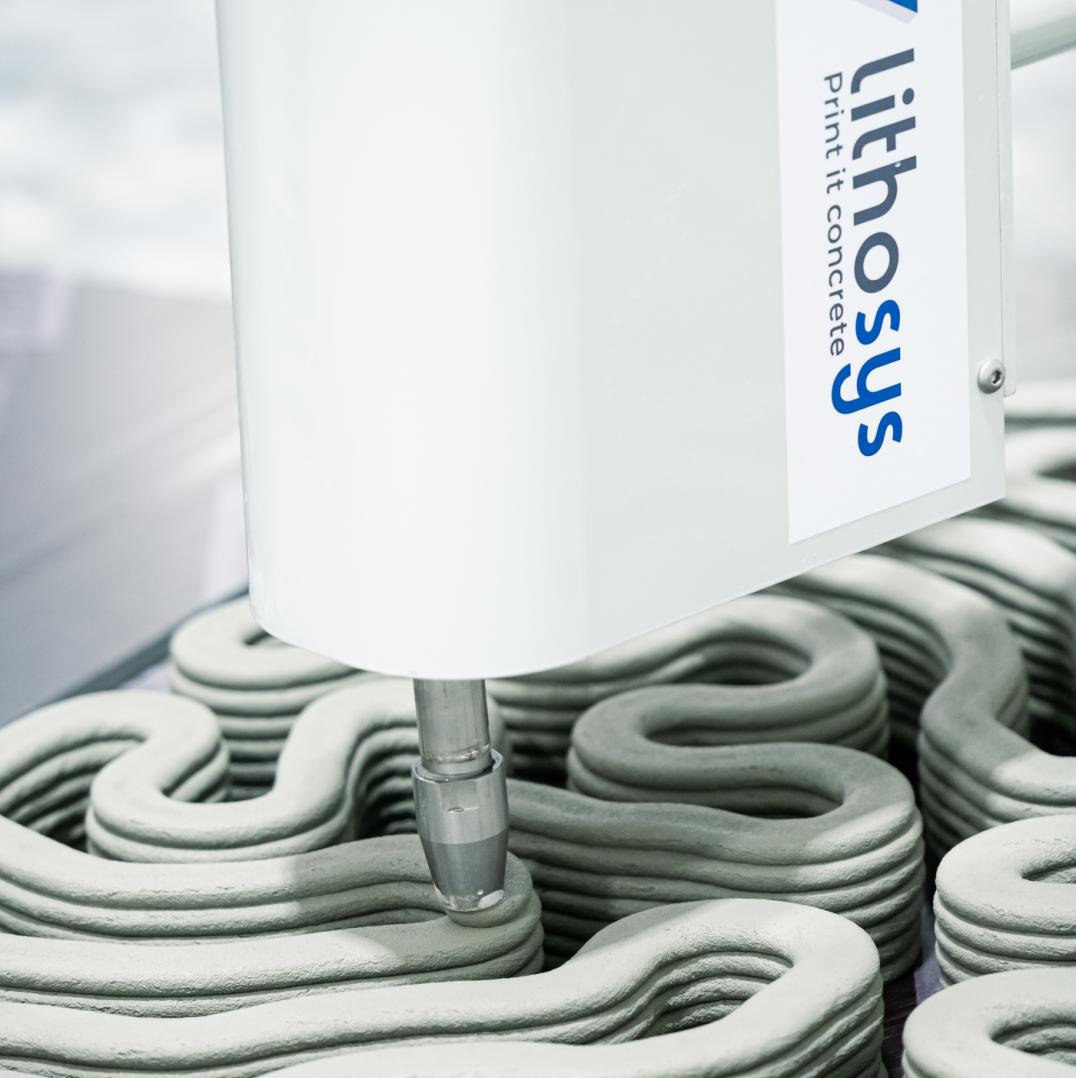
3D concrete printing, also known as additive manufacturing, is a breakthrough technology based on a simple principle. An extrusion robot applies specially formulated mortar, layer by layer, from a 3D digital model.
This revolutionary process:
- Creates complex geometries and organic shapes that are impossible to produce with traditional methods,
- Optimises material usage to reduce waste,
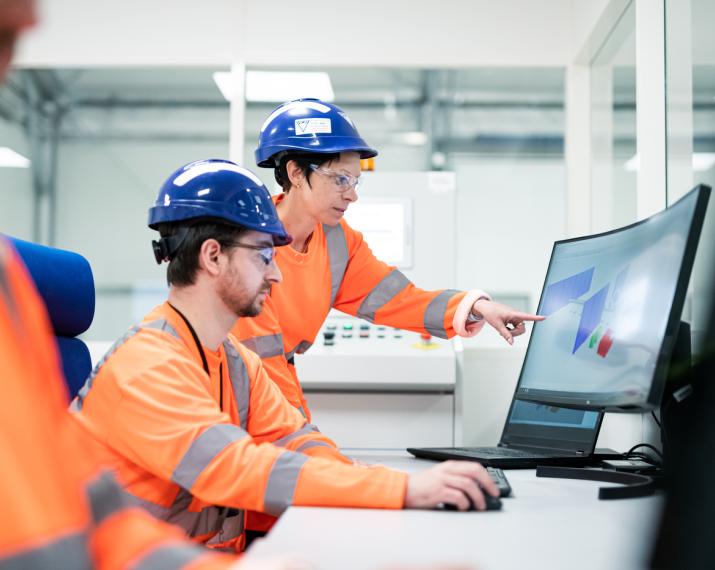
- Can connect 3D modelling (CAD) with robotics for precise automated production.
The Lithosys offer
Leading the way in innovation
The Vicat Group leveraged its technical and scientific expertise to develop Lithosys, a solution to accommodate a whole host of uses and push the boundaries of concrete material. This expertise covers the entire 3D concrete printing value chain, from design to completion, making Vicat a major stakeholder in additive manufacturing for construction.
3D concrete printing applications
A broad range of markets
3D concrete printing offers new opportunities for several building and planning sectors.
The myriad of possibilities with 3D concrete printing opens a wide range of markets
The four markets of concrete 3D printing
3D concrete printing applications
Construction
- - Custom-built site elements
- - Permanent formwork
- - Manhole covers
Prefabricated elements
- - Wide range of applications: columns, stairs, facades
- - Meshes
- - Concrete paving
- - Masonry work
Biodiversity
- - Artificial reefs
- - Complex deadman’s anchors
- - Wave attenuators
- - Floating wind farms and solar farms
Urban planning and interior design
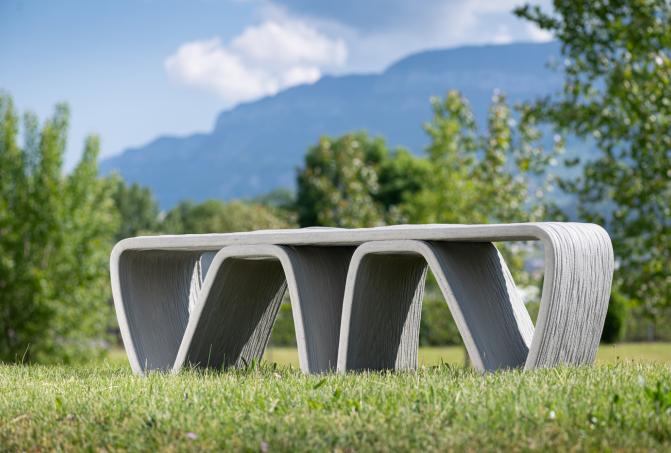
- - Public fixtures and amenities (benches, bus shelters, etc.)
- - Attractive furniture (tables, reception desks, etc.)
- - Art
Biodiversity: an example of an artificial reef
Immersion of the Octo-Cérébrum
The benefits of additive manufacturing
Up to 70% material savings
- - Optimised use of concrete: “The right concrete in the right place” (up to 70% less material).
- - Performance and durability: A range of cement inks developed for their resistance and lower carbon footprint.
- - Custom design and personalisation: Almost endless architectural and structural design possibilities.
- - Productivity and savings: An automated process with no need for costly formwork systems.
3D printing for construction stakeholders
titre
Tailored support
- Creation of objects to be manufactured using 3D printing
- Design and marketing of custom concrete inks to fit each individual application
- Installation of 3D concrete printing systems in workshops or on sites
- Manufacture of printed concrete elements
Concrete 3D printing and the construction sector
Advantages of concrete 3D printing

Materials :
- - Complete range of LITHOMIX materials
- - Performance tailored to applications
- - Constant focus on carbon footprint
- - Very high print quality control
- - Made in France

Technology :
- - Mixing – Pumping – Extrusion
- - Compatible with all new or existing systems
- - Custom development available

Software :
- - LITHOSIM software suite
- - User-friendly software developed according to needs
- - Integrated into Rhinoceros 3D
- - Compatible with all systems and robot brands
- - Custom development of industry-specific add-ons

Services :
- - Printing
- - Custom formulation
- - Prototyping, proof of concept
- - Support, assistance
LITHOMIX 3D ink
Gamme Lithomix CARAT
Lithomix CARAT is a range of printable materials which offer optimal performance, allowing a material reduction of up to 70% and a significant drop in CO₂ emissions.
Check out the characteristics of our Lithomix ink range:
- - High resistance up to 60MPa
- - Single or two-component according to project requirements
- - Compatible with batch or continuous mixing
- - Excellent pumpability: from 3 to 15 L/min depending on the pump used
- - High constructability: up to 6 seconds between two 1K layers
Bespoke formulation according to applications and designs
A production workshop 100% dedicated to customer support and service
With Lithosys, Vicat continues its research and development work in the field of 3D low carbon concrete ink formulation, adapted to the requirements of current standards and regulations. The Group invested 2 million euros in a production and R&D unit dedicated to concrete 3D printing, located in Chambéry (Savoie, France), confirming its commitment to this technology of the future.
Frequently asked questions about 3D concrete printing
3D concrete printing significantly reduces construction times: faster than traditional methods depending on project complexity while preserving optimal quality.
3D printed concrete elements have mechanical compressive strength performance of up to 60Mpa, with the advantage of topological optimisation.
Yes, it is! Additive manufacturing reduces the volume of concrete used by 70%, reduces on-site waste and optimises transport because of local production.
Architecture, urban planning, prefabricated elements, emergency housing, heritage restoration, ecological mooring devices, coastal planning, marine infrastructure – 3D concrete printing is suitable for numerous applications in construction.
Lithosys: 3D printing by Vicat